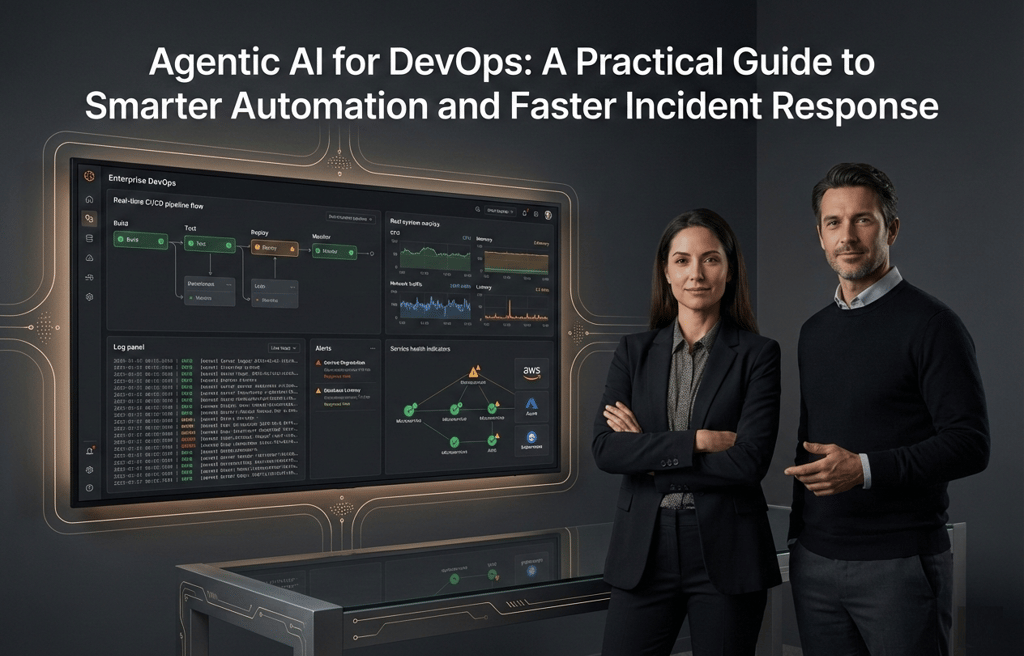
Agentic AI for DevOps: A Practical Guide to Smarter Automation and Faster Incident Response
See how Agentic AI improves DevOps with faster incident response, reduced MTTR, and adaptive automation that enhances reliability and cuts costs.
Aishwarya
11/21/20257 min read
Modern DevOps teams are operating in an environment where systems scale faster than people can manage. Systems scale across multiple clouds. Pipelines run at all hours. New releases introduce new variables every week. Incident response demands immediate clarity, yet engineers often sift through fragmented data before they can act. Even with automation, the operational burden continues to grow.
Uptime Institute’s 2025 Outage Analysis Report shows that nearly 40% of major outages stem from human error, with 85% tied to procedural failures or gaps in existing processes. These numbers underline a growing problem: automation alone cannot keep pace with the complexity and speed at which modern systems operate.
This is why more teams are exploring Agentic AI, not as a replacement for DevOps talent, but as an intelligence layer that supports teams with continuous observation, adaptive reasoning, and real-time actions. The result is a more predictable, efficient, and resilient operational environment.
This guide breaks down what Agentic AI means for DevOps, how it expands the capabilities of today’s tools, and how leaders can start unlocking value within weeks, not months.
The Real Cost of Slow Incident Response
Before discussing how Agentic AI improves DevOps performance, it is important to understand the tangible operational and financial impact of slow incident response. The numbers show a widening gap between the complexity of modern systems and the ability of teams to keep up.
Unplanned downtime is expensive. Industry research shows that downtime costs range from $8,000 to $25,000 per hour for small businesses and exceed $1 million per hour for large enterprises, with high-risk sectors facing losses of $5 million per hour or more.
Incident volume continues to rise. Check Point’s Q1 2025 Global Cyber Attack Report shows that organizations faced an average of 1,925 attacks per week, a 47% jump from 2024. This surge in attack volume adds substantial pressure on DevOps and SRE teams already managing complex, high-velocity environments.
Attackers are moving faster. The median time between system compromise and data exfiltration fell to just two days, shrinking the window that teams have to detect and contain threats before damage escalates.
Most teams are not satisfied with their response speed. Only 19% of teams achieve an MTTR under one hour, while the remaining 81% take a day to a week or more to recover. The performance gap shows how most organizations struggle to respond at the pace modern systems demand.
Resolving incidents still takes hours for most teams. According to the New Relic Observability Forecast 2024, engineering teams spend an average of 30% of their time addressing disruptions, which amounts to approximately 12 hours in a 40-hour work week.
The hidden cost is an innovation slowdown. Every hour engineers spend on firefighting is an hour not spent on product enhancement, feature delivery, or technology improvement. Teams often cite on-call fatigue and burnout as direct consequences of repeated slow-moving incidents.
This environment creates pressure for a smarter, more adaptive layer of automation that can reduce manual load, shorten MTTR, and allow teams to focus on strategic work instead of constant reaction.
What Agentic AI Brings to DevOps
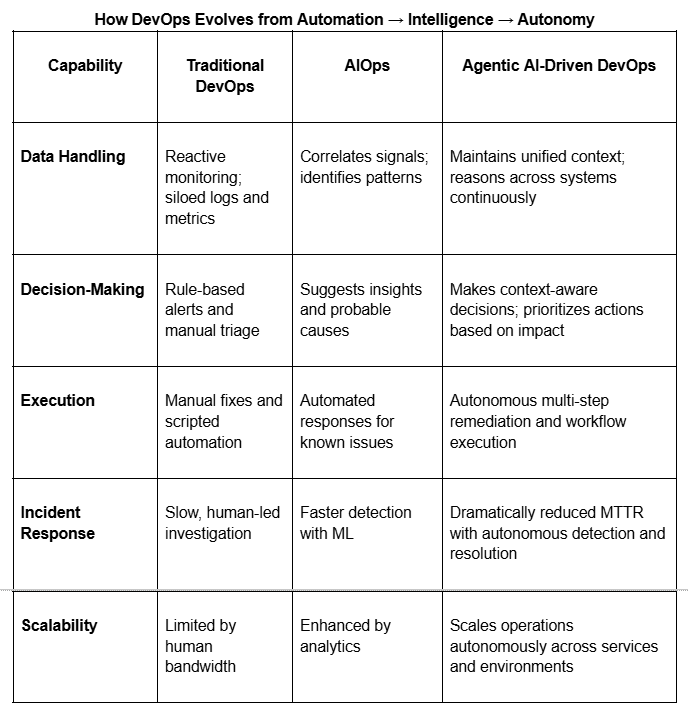
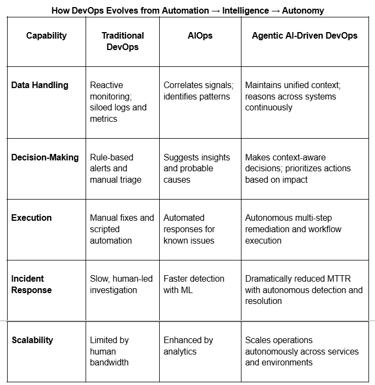
Traditional DevOps automation excels at predefined rules: if X happens, do Y. But real environments rarely fit perfectly into predictable patterns. Errors cascade. Services trigger noise. Metrics conflict. Context shifts.
Agentic AI introduces three new capabilities that change how DevOps operates:
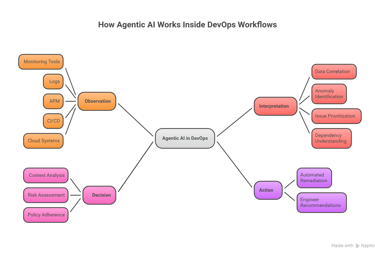
Continuous Observation
The system analyses logs, metrics, traces, and pipeline signals as one unified flow rather than isolated data. It maintains contextual awareness across services, dependencies, and events.
Contextual Reasoning
Instead of reacting to rules, the AI evaluates conditions, predicts outcomes, weighs options, and determines the most suitable response. It doesn’t need exact instructions for every scenario.
Autonomous Action
Once confident in its understanding, Agentic AI can execute tasks such as scaling resources, remediating common issues, rolling back faulty deployments, or alerting engineers with a fully prepared context.
This combination helps DevOps move from reactive workflows to intelligent, proactive operations.
Where Agentic AI Improves DevOps Today
1. Faster, Clearer Incident Response
Every incident begins with the same challenge: understanding what actually happened.
Agentic AI accelerates this by assembling a full picture in seconds, correlating logs, matching patterns, detecting anomalies, and identifying probable root causes.
Instead of paging engineers with vague alarms, the AI delivers a clear explanation, recommended steps, and in many cases, executes the corrective action automatically.
For teams responsible for uptime, this can significantly reduce MTTR and help maintain stronger Service Level Objective (SLO) performance.
2. Reducing Alert Fatigue and Operational Noise
Most DevOps teams deal with alert floods, especially in distributed architectures.
Agentic AI filters noise by grouping related alerts, suppressing duplicates, and highlighting only those that warrant attention. It dynamically adjusts thresholds based on real-time context rather than static configurations.
This not only improves focus but also reduces stress for on-call engineers, particularly during rapid scaling or release windows.
3. Smarter Continuous Integration (CI) and Continuous Delivery (CD) Pipelines
Pipelines generate huge amounts of telemetry, yet most insights go unused.
Agentic AI learns from build patterns, test failures, deployment timings, and system performance. It identifies flaky tests, predicts failing builds, and flags high-risk changes before they reach production.
Teams gain the freedom to ship faster with fewer surprises, especially in environments with frequent deployments.
4. Self-Healing Infrastructure and Environments
Common operational issues, service restarts, node failures, and resource bottlenecks can be resolved automatically.
Agentic AI takes action the moment it detects a symptomatic pattern, using pre-validated playbooks or adaptive remediation sequences.
This reduces manual intervention and maintains system stability even during peak activity.
5. Real-Time Optimization and Cost Control
For teams operating across cloud platforms, resource waste is a constant concern.
Agentic AI monitors usage, identifies inefficiencies, right-sizes resources, and automates routine cleanup tasks. It can also suggest architectural adjustments based on demand patterns.
This helps organizations control costs without compromising availability or performance.

What This Means for Business Outcomes
For decision-makers, the value of Agentic AI lies not only in its technical novelty but also in its impact on business performance.
Lower operational costs by reducing manual intervention
Faster recovery during incidents, protecting customer experienc
More stable releases due to proactive pipeline and system monitoring
Better team morale as repetitive tasks decrease
Higher reliability that supports revenue-generating systems
Greater predictability in DevOps operations, enabling better planning
Studies show that companies that adopt intelligent automation in their operations experience a 40% increase in productivity within the first year. Agentic AI accelerates this shift at the system level.
Explore our blog section for in-depth insights and practical strategies on how leading organizations are integrating Agentic AI to drive smarter, more efficient operations.
Practical Use Cases You Can Implement Now
Agentic AI is not theoretical. Here are real applications already delivering results:
Incident correlation: Identify related failures across microservices.
Log intelligence: Spot anomalies without manually scanning millions of lines.
Self-healing systems: Auto-scale, auto-restart, or auto-recover services.
Pipeline optimization: Detect slow stages, instability, and regression patterns.
Security event triage: Flag irregular access behavior or configuration drift.
Each use case reduces operational burden and improves engineering efficiency.
Building Your Agentic AI DevOps Strategy: A Quick Practical Roadmap
Start with High-Impact, Low-Risk Areas
Don't attempt to transform your entire DevOps lifecycle overnight. Begin with specific pain points:
Alert triage and initial incident classification
Routine deployment tasks with clear success criteria
Log analysis and pattern recognition
Infrastructure monitoring and basic remediation
Establish Clear Observability
You can't delegate what you don't measure. Clean, unified telemetry is the bedrock of any agentic system. Before implementing Agentic AI, ensure you have comprehensive monitoring, logging, and metrics collection in place. The AI needs quality data to learn from and act upon.
Design for Human Oversight
Autonomy doesn't mean absence of control. Autonomy must come with auditability. That means strict role boundaries and human override paths. Start with systems that recommend actions and require approval, then gradually expand autonomy as confidence builds.
Focus on Integration
Your Agentic AI solution must work seamlessly with existing tools (Kubernetes, Jenkins, GitHub, cloud platforms). Look for systems designed to integrate rather than replace your current stack.
Common Concerns and Practical Considerations
"What if the AI makes a mistake?"
Start with guardrails. Implement approval workflows for high-risk changes, establish rollback mechanisms, and maintain comprehensive audit logs. As the system proves reliable in lower-risk scenarios, you can expand its autonomy incrementally.
"Will this replace our DevOps engineers?"
No. Agentic DevOps isn't about replacing engineers. It's about evolving the systems they depend on, so they can focus on harder, higher-value problems. Your team shifts from firefighting to innovation, from reactive maintenance to strategic improvements.
"How do we measure success?"
Mean Time to Repair (MTTR): How quickly incidents are detected, diagnosed, and closed after adopting Agentic AI.
Deployment Frequency: The increase in safe, repeatable deployments released per day or week.
Change Failure Rate: How many deployments lead to incidents or rollbacks, and how this improves over time.
On-Call Load: Reduction in alerts, after-hours escalations, and high-severity incidents requiring human intervention.
Engineering Time Reclaimed: Hours previously spent on manual triage, restarts, log analysis, or repetitive tasks, now redirected to feature delivery and innovation.
Still think Agentic AI is too complex to implement? Many leaders using our eBook Agentic AI for Business Leaders are streamlining workflows and reclaiming 30+ hours each month. Download your FREE copy now!
The Elevin Advantage: Implementing Agentic AI to Your DevOps
At Elevin Consulting, we understand that adopting Agentic AI isn't just about technology; it's about transformation. Our approach focuses on your specific pain points, existing infrastructure, and business objectives.
We help you:
Assess readiness: Evaluate your current DevOps maturity and identify optimal entry points for Agentic AI
Design intelligently: Architect solutions that integrate with your existing tools and workflows
Implement strategically: Deploy in phases, proving value quickly while building toward comprehensive automation
Measure results: Establish clear metrics that demonstrate ROI in terms of time savings, cost reduction, and operational efficiency
Our Agentic AI services are designed for organizations that want to move beyond theoretical discussions and implement practical solutions that deliver measurable business value.
Looking Ahead: The Future of DevOps is Intelligent
Over 80% of organizations now practice DevOps, which will increase to 94% in the near future. But practicing DevOps and excelling at it are different things. The next competitive advantage belongs to organizations that augment their teams with intelligent systems.
We're entering an era where specialized agents working together across domains will handle infrastructure provisioning, security compliance, performance optimization, and incident response simultaneously, all while learning from each interaction.
The question isn't whether Agentic AI will transform DevOps, but whether your organization will lead this transformation or play catch-up.
Take the Next Step
If your team is struggling with incident response times, deployment bottlenecks, or operational complexity, it's time for a conversation. The gap between your current DevOps capabilities and what's possible with Agentic AI represents untapped efficiency, hidden cost savings, and unrealized competitive advantage.
Schedule a free discovery call with Elevin's Agentic AI experts. We'll assess your specific challenges, explore practical solutions, and create a roadmap tailored to your business objectives.
Excellence
Elevin Consulting: Your Partner in Growth.
Impact
© 2025 Elevin Consulting Pvt Ltd. All Rights Reserved
Trust
hello@elevinconsulting.com