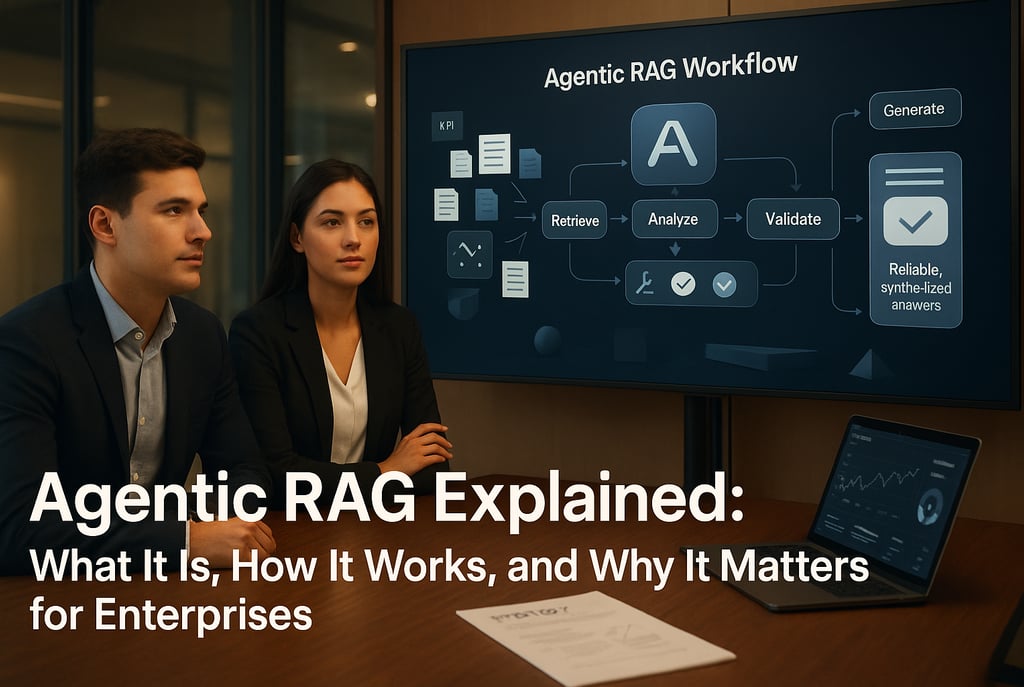
Agentic RAG Explained: What It Is, How It Works, and Why It Matters for Enterprises
Agentic RAG explained for enterprises. Understand its architecture, benefits, and impact on accuracy, automation, and operational performance.
Aishwarya
11/19/20256 min read
If you are an enterprise leader trying to make sense of rapidly growing data, rising customer expectations, and constant operational pressure, you already know the real challenge is not access to information. It is the time your teams lose searching for it, validating it, and turning it into decisions they can trust. Knowledge lives across tools, departments, and outdated documents, and even with AI chatbots or internal search systems, answers often feel incomplete or unreliable.
This slows down projects, affects customer experience, increases risk, and creates bottlenecks that directly impact business outcomes.
This is where Agentic RAG (Retrieval Augmented Generation) is becoming essential. It goes beyond traditional RAG by adding reasoning, validation, memory, and autonomous actions. Instead of simply retrieving information, it acts like a digital teammate that analyzes, checks, and executes.
This guide explains what Agentic RAG is in simple terms, how it works, and why forward-thinking enterprises are adopting it to improve decision-making, increase efficiency, and scale intelligent automation.
What Is Agentic RAG?
Agentic RAG (Retrieval-Augmented Generation) represents the evolution of standard RAG systems by introducing autonomous decision-making agents into the retrieval and generation process.
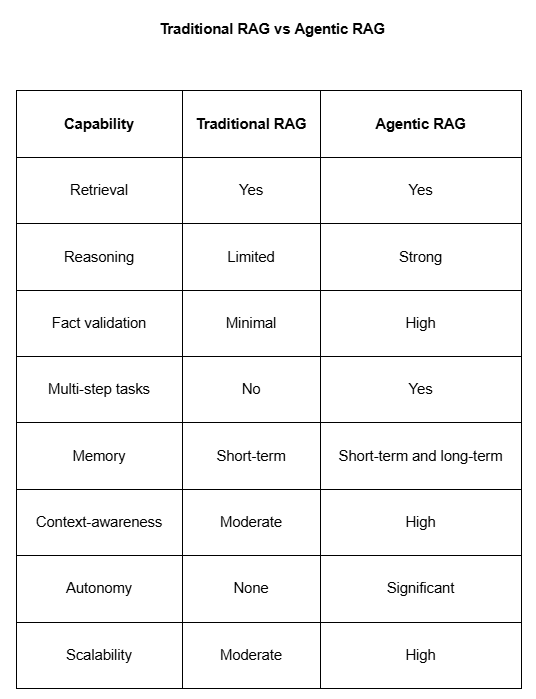
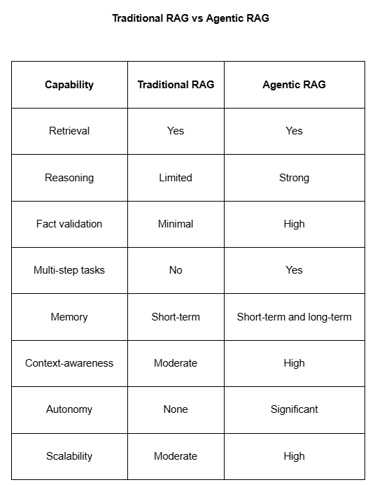
Traditional RAG systems retrieve relevant information from a knowledge base and feed it to a language model to generate responses. While this improves accuracy over pure generative AI, it's still passive and linear.
The agentic approach adds a critical layer: intelligent agents that can reason about queries, strategically decide where to look for information, validate sources, and iteratively refine their approach until they deliver comprehensive, reliable answers. Think of it as upgrading from a basic search engine to a strategic research assistant that knows when to dig deeper, cross-reference sources, and question its own assumptions.
How Agentic RAG Works: The Architecture Behind the Intelligence
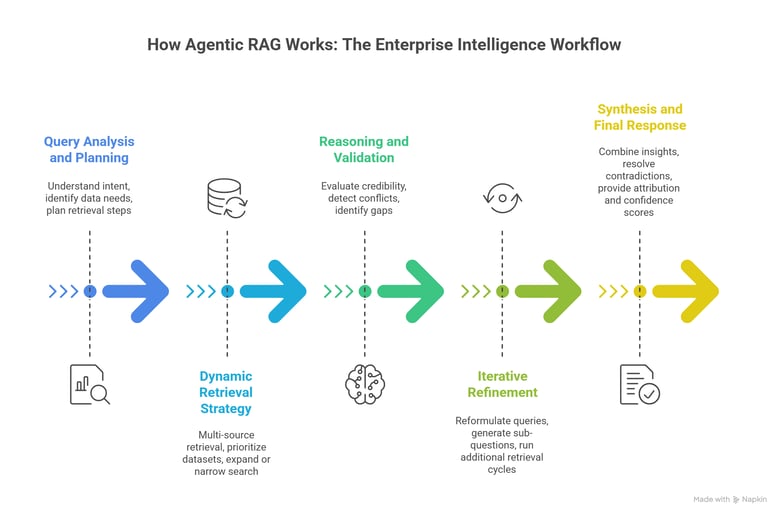
Understanding how Agentic RAG delivers more reliable and actionable results starts with looking at how its components work together. Instead of performing a single retrieve and generate step like traditional RAG, it operates through a multi-stage intelligent workflow.
1. Query Analysis and Planning
When a user asks a question, the system does not immediately start retrieving documents. It first analyzes the intent, complexity, and information requirements. The agent determines what type of data is needed, which systems to query, and what steps are required to produce a complete answer.
For example, asking about Q4 revenue trends compared to competitor performance triggers the need for internal financial records, competitor benchmarks, industry reports, and market trends. The agent creates a strategic plan before taking any retrieval action.
2. Dynamic Retrieval Strategy
Traditional RAG performs one retrieval round. Agentic RAG uses an adaptive retrieval strategy that evolves based on real-time findings.
The agent intelligently decides:
Where to search
Which datasets to prioritize
When to expand or narrow the scope
Whether additional external sources are required
It may start with your internal databases, move to knowledge bases, analyze industry reports, and then pull real-time feeds. Each step is based on the quality and completeness of what it finds.
3. Reasoning and Validation
This is the layer that sets Agentic RAG apart. After retrieving information, the system evaluates:
Source credibility
Conflicting information
Missing or incomplete details
Consistency between data points
Confidence levels
The agent determines whether it has enough reliable information or if more retrieval is needed. This dramatically reduces hallucinations and improves response accuracy.
4. Iterative Refinement
If the initial retrieval reveals gaps, the agent automatically adjusts its strategy. It may:
Reformulate queries
Break down complex questions
Explore alternate data sources
Conduct additional retrieval cycles
This iterative approach mirrors how expert analysts work to ensure a complete and reliable understanding.
5. Synthesis and Response Generation
Once the agent has collected and validated the necessary information, it synthesizes insights from multiple sources, resolves contradictions, and prepares the final response.
Enterprise users receive:
Clear answers
Context for how the system arrived at the conclusion
Proper attribution
Confidence indicators
This creates transparency and reliability that traditional RAG approaches cannot deliver.
Why Traditional RAG Is Not Enough for Enterprise Needs
Gartner predicts that by 2028, 15% of all routine business decisions will be made autonomously by agentic AI, marking one of the fastest shifts in enterprise decision-making in decades. The message is clear: organizations that fail to upgrade their AI foundations will fall behind. However, traditional RAG may fall short of powering this transformation, often leaving enterprises with incomplete, unverified, or unreliable insights.
It suffers from critical limitations:
Single-pass retrieval that misses nuanced or scattered information
No reasoning to evaluate source quality or resolve conflicts
No adaptation when the initial retrieval is incomplete
No transparency into how answers were created
No ability to perform multi-step analysis
Higher susceptibility to hallucinations
McKinsey Global Survey on the state of AI found that 51% of organizations using AI experienced at least one negative consequence, with nearly one-third attributing issues to AI inaccuracy. For enterprises operating in regulated sectors, high-stakes workflows, or complex environments, this is more than an inconvenience. It is a real operational and compliance risk. Systems that provide incomplete or inaccurate answers can damage trust, slow adoption, and expose organizations to avoidable failures.
Agentic RAG solves these gaps with multi-step planning, validation, and autonomous action.
Explore our blog section for deeper insights and practical strategies on how leading organizations are adopting Agentic AI to create smarter, more efficient operations.
Why Enterprises Need Agentic RAG Now
1. The Data Complexity Crisis Is Accelerating
Enterprise data volumes are doubling every two years. Data is also becoming more fragmented across cloud platforms, SaaS tools, internal systems, and legacy environments. Traditional search methods cannot keep up, leaving critical insights buried.
Agentic RAG autonomously navigates this complexity, reducing the time teams spend searching for information and improving decision quality.
2. AI Accuracy Expectations Are Rising
Tolerance for AI errors is disappearing. Customers, employees, and regulators expect reliability. One incorrect recommendation can undermine trust built over months.
Agentic RAG’s built-in reasoning and verification provide the accuracy assurance enterprises now require.
3. Competitors Are Already Moving
Forward-thinking organizations are deploying agentic systems to improve decision-making, accelerate workflows, and enhance customer experiences. IBM research shows that early adopters report three times higher ROI from AI investments.
Delaying adoption increases the competitive gap.
4. Regulatory Pressure Requires Transparency
New AI regulations across the EU and US demand explainability and auditability. Black-box AI is becoming unacceptable. Agentic RAG’s source attribution, reasoning chains, and traceability align with emerging compliance standards.
5. Talent Retention Depends on Better Tools
Knowledge workers lose faith when tools slow them down. Intelligent systems that amplify human capability directly improve job satisfaction and retention, especially in competitive talent markets.
Business Impact: Where Agentic RAG Delivers Real Value
1. Enhanced Decision-Making Speed
Enterprise leaders spend up to 23% of their time searching for information. Agentic RAG drastically reduces this by autonomously gathering, validating, and synthesizing data across sources.
2. Improved Operational Efficiency
Support teams see 30 to 50% faster resolutions because the agent navigates knowledge bases, systems, and context automatically.
3. Risk Reduction Through Validation
In regulated sectors, the validation and attribution capabilities provide reliable audit trails and reduce compliance risks.
4. Scalable Knowledge Management
By making organizational knowledge accessible regardless of where it lives, enterprises gain resilience during mergers, expansion, or digital transformation initiatives.
Real-World Applications Across Industries
1. Financial Services
Investment teams use this technology to analyze market trends, regulatory filings, financial statements, and news sources at scale. The system identifies patterns and anomalies that human analysts may miss.
2. Healthcare
Hospitals deploy agentic systems to assist clinicians with complex cases by pulling patient histories, research insights, and clinical guidelines while maintaining HIPAA compliance.
3. Manufacturing and Supply Chain
Manufacturers optimize operations by integrating IoT data, supplier databases, logistics trackers, and inventory systems. The system predicts disruptions and recommends adjustments.
4. Legal and Compliance
Law firms and in-house legal teams use agentic systems to navigate case law, contracts, regulatory archives, and precedent databases with precise attributions.
Key Considerations for Enterprise Implementation
1. Data Infrastructure Requirements
Successful deployment requires clean and accessible data. Enterprises should evaluate their current data landscape, integration points, and metadata quality.
2. Security and Privacy
Robust security controls, encryption, and access management ensure agents operate autonomously without compromising data integrity.
3. Human-in-the-Loop (HITL) Oversight
For high-stakes decisions, the best results come from human expertise working alongside agentic intelligence.
4. Performance Metrics and Monitoring
Organizations should measure accuracy, retrieval efficiency, satisfaction scores, and business impact to ensure continuous improvement.
Still think Agentic AI is too complex to implement? Many leaders using our eBook Agentic AI for Business Leaders are streamlining workflows and reclaiming 30+ hours each month. Download your FREE copy now!
How Elevin Accelerates Your Agentic AI Journey
Successful deployment requires more than technology. It requires strategic planning, data understanding, and alignment with business objectives.
Elevin Consulting specializes in helping enterprises navigate this complexity. Our expertise spans:
AI maturity assessment
High-impact use case identification
Scalable architecture design
Governance and compliance frameworks
Full implementation and optimization
With us, you gain a partner committed to clarity, operational impact, and proven ROI. Our experience implementing agentic AI solutions ensures your investment translates into measurable improvements in efficiency, decision accuracy, and overall business performance.
When Should Your Enterprise Adopt Agentic RAG?
You should consider implementing Agentic RAG if your organization:
Manages large volumes of unstructured data
Struggles with inconsistent or slow knowledge retrieval
Needs to improve cross-functional decision-making
Operates in a regulated or risk-sensitive industry
Wants to reduce operational costs without adding headcount
If any of these apply, Agentic RAG can significantly enhance how your teams operate and collaborate.
Conclusion
Agentic RAG is not an incremental improvement. It is a foundational shift in how enterprises access knowledge, make decisions, and operate at scale. With reasoning, validation, and autonomous capabilities, organizations gain faster insights, stronger accuracy, and smarter workflows.
If your enterprise is ready to unlock the next level of intelligent automation, Elevin is ready to guide your journey.
Excellence
Elevin Consulting: Your Partner in Growth.
Impact
© 2025 Elevin Consulting Pvt Ltd. All Rights Reserved
Trust
hello@elevinconsulting.com