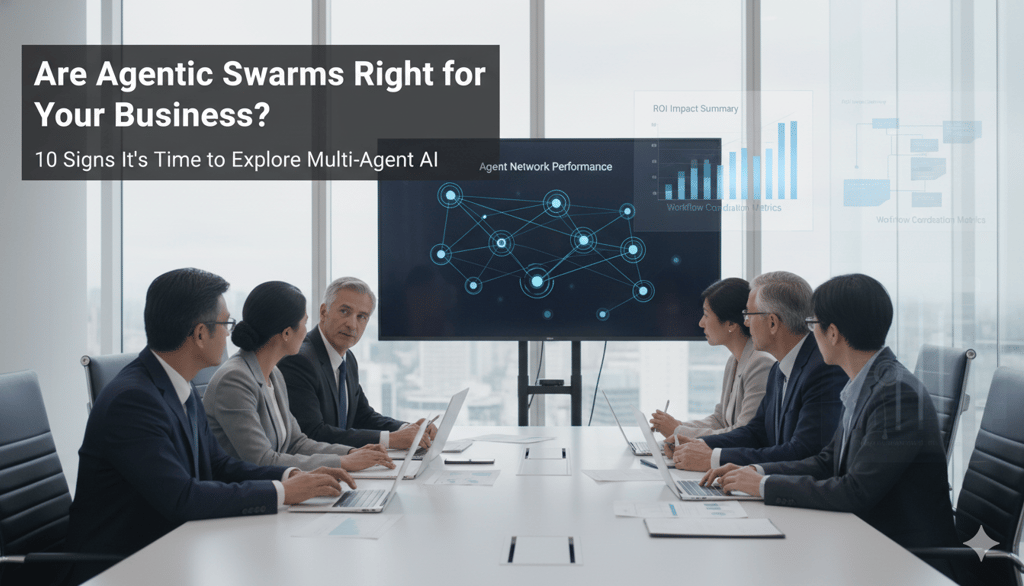
Are Agentic Swarms Right for Your Business? 10 Signs It’s Time to Explore Multi-Agent AI
Is your business held back by complex workflows? Discover 10 signs you need Agentic AI swarms to boost efficiency, decision-making, and growth.
Aishwarya
11/9/20258 min read
Introduction
Artificial intelligence has become a part of daily operations for many organizations. From customer support bots to data analytics platforms, AI tools are improving speed and accuracy across multiple functions. Yet, in many businesses, these tools still work in isolation.
According to an IDC 2024 enterprise survey, 39 percent of companies reported using more than five unconnected AI systems. The result is overlapping workflows, repeated data handling, and slower decisions.
To overcome this, some organizations are adopting multi-agent systems, often referred to as Agentic Swarms or Swarm Agentic AI. These systems allow multiple AI agents to collaborate toward shared objectives. Instead of automating single tasks, they coordinate decisions, information, and actions across departments.
If your organization is already using AI but is finding that its impact has plateaued, the following 10 indicators can help you determine whether Agentic Swarms could be the logical next step.
What Are Agentic Swarms? (And Why They Matter Now)
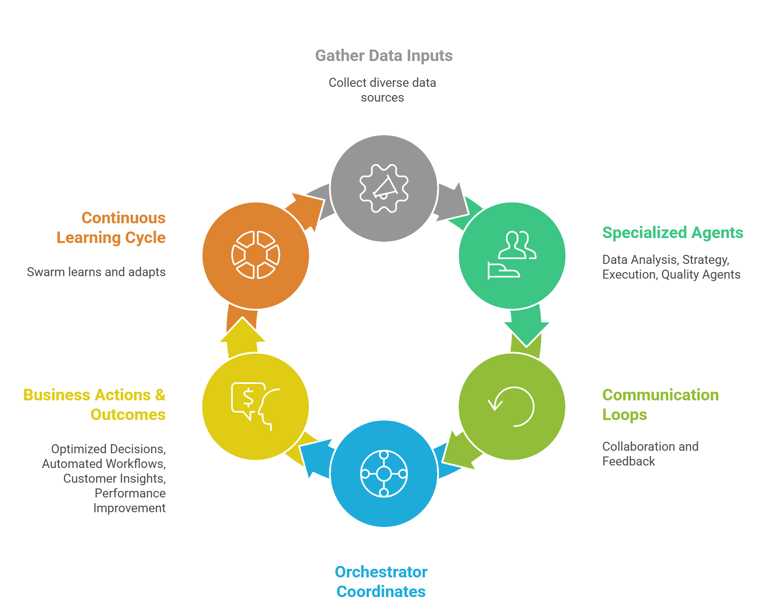
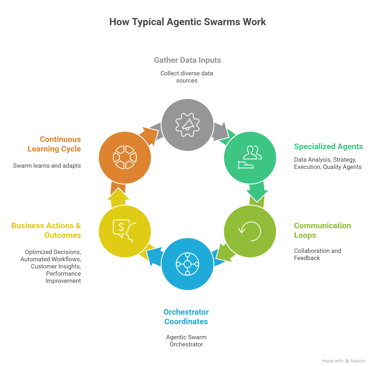
Think of agentic swarms as digital teams where each member is an AI agent with specific skills and responsibilities. Unlike traditional automation that follows rigid scripts, these agents can reason, adapt, and collaborate in real time to solve complex problems.
Research shows that multi-agent systems enable groups of intelligent agents to coordinate and solve complex tasks collectively at scale, transitioning from isolated models to collaboration-centric approaches.
Here's what makes them different:
Traditional Automation: A single bot follows a predefined workflow. If conditions change or exceptions arise, it breaks or requires human intervention.
Single Agent AI: One AI system handles end-to-end processes but struggles with tasks requiring multiple types of expertise or simultaneous actions.
Multi-Agent Swarms: A network of specialized agents collaborates dynamically. One agent handles data analysis while another manages customer communication, and a third coordinates logistics. They adapt their strategies based on real-time feedback and emerging patterns.
In 2024, the multi-agent segment captured more than 66.4% share of the agentic AI market, signaling where enterprise investment is flowing.
10 Signs It’s Time to Explore Multi-Agent AI Swarms
Recognizing when your business is ready for Agentic Swarms requires more than curiosity about the technology. It starts with identifying operational patterns where coordination, adaptability, and distributed intelligence could deliver tangible results. The following signs indicate that your organization may benefit from exploring multi-agent AI systems.
1. You rely on several AI tools that don’t communicate
Many companies implemented AI rapidly across different departments. Marketing uses automation for campaigns, operations uses bots for task management, and analytics runs on separate platforms. While each system adds value on its own, they rarely share data or insights. The result is duplicated effort, disconnected decisions, and slow cross-team communication.
How Agentic Swarms help:
Agents can bridge these silos by connecting existing tools through a shared coordination layer. They exchange information automatically, align goals across departments, and ensure data consistency throughout the organization.
Business impact:
Companies adopting this approach report 30–35% faster decision-making and reduced human error due to synchronized data across platforms. In fact, Direct Mortgage Corp. reduced loan processing costs by 80% with 20x faster application approval by letting agent swarms handle cross-functional coordination.
2. Decision-making is slowed by reporting delays
Leadership often waits days or even weeks for manual reports. Analysts spend time preparing summaries, while managers base their choices on outdated numbers. This delay creates a gap between what’s happening and what decisions are made, especially in dynamic markets where timing determines competitiveness.
How Agentic Swarms help:
In a swarm structure, data collection, processing, and visualization happen simultaneously. One agent pulls live data, another analyzes it, and a third presents actionable insights directly to decision-makers.
Business impact:
Organizations achieve up to 40% shorter reporting cycles and make faster, data-backed decisions, minimizing the lag between analysis and action.
3. Scaling operations still depends on adding more people
As workloads increase, many organizations respond by hiring more staff or outsourcing. While this may solve short-term capacity issues, it also raises costs and complicates management. Growth becomes linear rather than scalable, and productivity gains eventually stall.
How Agentic Swarms help:
Multi-agent systems allow operations to scale horizontally. Agents redistribute workloads, manage scheduling, and replicate themselves during peak periods. Instead of adding staff, businesses expand through adaptive automation.
Business impact:
Companies using swarm-based scaling report 3–5x higher output without increasing headcount, keeping efficiency and quality consistent during rapid growth.
4. Customer issues are identified too late
In most support environments, teams react after a problem occurs. A customer submits a complaint, a review signals dissatisfaction, or an issue surfaces after a loss. These reactive models reduce customer trust and increase churn.
How Agentic Swarms help:
Agents can monitor feedback, sentiment, and usage data continuously. When early warning patterns emerge, such as repeated error messages or negative tone, the system flags or resolves the issue before it escalates.
Business impact:
Implementing multi-agent AI systems in customer support can significantly elevate the customer experience, with reported increases of 15-25% in customer satisfaction scores (CSAT) attributed to their use.
5. Cross-department projects lose momentum at handoffs
Projects often move slowly between departments. After one team completes its work, another waits for updates, clarification, or manual approval. The longer the chain of communication, the higher the chance of misalignment or delay.
How Agentic Swarms help:
In a swarm setup, coordination agents manage dependencies and initiate follow-up actions automatically. When a milestone is reached, the next task triggers without waiting for a human prompt.
Business impact:
Organizations experience 25–30% shorter project delivery timelines and smoother transitions between departments.
6. Leadership lacks a real-time view of operations
Executives typically rely on departmental dashboards that show only fragments of the business. Without unified visibility, it’s difficult to identify risks early or track performance across multiple functions.
How Agentic Swarms help:
Agents aggregate and summarize data from all connected systems, creating a single, constantly updated view of operations. Decision-makers gain accurate insights at any moment rather than relying on periodic reports.
Business impact:
Better visibility enables faster corrective actions, improved forecasting, and higher strategic agility.
7. You have compliance requirements across multiple jurisdictions
As companies expand into new markets, compliance becomes increasingly complex. Teams must track evolving regulations, maintain documentation, and prepare audit trails, often across multiple jurisdictions with varying reporting standards. Managing this manually consumes significant time and increases the risk of missed updates or inconsistent records.
How Agentic Swarms help:
Specialized agents can continuously monitor regulatory databases, flag policy changes, and coordinate compliance workflows. Documentation agents ensure every step is logged and easily retrievable for audits. According to a 2025 Moody's report, the adoption of AI for risk and compliance is soaring: more than half (53%) of organizations are currently using or trialing the technology, a 23-point increase from the prior year.
Business impact:
Organizations using agent-driven compliance see reduced audit preparation time, lower legal risk exposure, and significant cost savings from automating monitoring and reporting tasks.
8. Knowledge stays confined within teams
Information often gets trapped on local drives, emails, or team-specific systems. When employees move or departments restructure, valuable expertise disappears. This limits cross-functional learning and slows future projects.
How Agentic Swarms help:
Knowledge agents maintain institutional memory by capturing, tagging, and sharing critical information across teams. They make organizational expertise searchable and reusable.
Business impact:
New employees onboard faster, repeated mistakes decline, and collaboration improves because information is easily accessible and continuously updated.
9. Successful AI pilots fail to scale company-wide
Many companies have promising AI pilots that never expand beyond their original teams. Integration challenges, governance issues, and inconsistent results make scaling difficult. As a result, AI investments stay isolated instead of driving enterprise-wide transformation.
How Agentic Swarms help:
Swarm frameworks allow pilot agents to scale modularly. Once validated, they can be replicated and deployed across new workflows under shared coordination and monitoring.
Business impact:
Businesses see 25–40% higher efficiency and consistent results across multiple departments, avoiding the fragmentation common in standalone pilot programs.
10. Your competitors are already exploring advanced automation
AI adoption is no longer experimental. Across industries, companies are moving beyond single-task automation to systems that learn, plan, and collaborate. Competitors are using multi-agent frameworks to accelerate product delivery, reduce operational costs, and improve decision-making speed. Waiting too long to evolve from isolated AI tools can leave your organization behind in efficiency and responsiveness.
How Agentic Swarms help:
Agentic Swarms bring structure and coordination to automation, allowing businesses to deploy intelligent systems that adapt continuously. They help organizations transition from piecemeal improvements to integrated, enterprise-wide intelligence.
Business impact:
According to a report, 9 out of 10 organizations support AI for a competitive advantage. Adopting Agentic Swarms now positions your organization to stay competitive as automation maturity becomes a differentiator.
The Business Value of Agentic Swarms: ROI Beyond Automation
The benefits of Agentic Swarms extend far beyond simple task automation. They translate directly into tangible business value:
Revenue Growth: By accelerating innovation, optimizing customer experiences, and enabling faster market response.
Operational Efficiency: Through streamlined processes, optimized resource allocation, and proactive problem-solving.
Enhanced Decision-Making: With real-time data analysis, predictive insights, and reduced human bias.
Significant Cost Savings: By reducing manual labor, preventing errors, and optimizing resource use.
Increased Time Savings: Freeing up valuable human capital for strategic initiatives.
Accenture research indicates that firms with advanced AI capabilities, termed "AI Achievers," experienced 50% greater average revenue growth and are 3.5 times more likely to have over 30% of revenue influenced by AI. Agentic swarms can take this edge further by enabling truly autonomous, collaborative intelligence.
Explore our blog section for in-depth insights and real-world strategies on how leaders across industries are adopting Agentic AI to build smarter, more efficient operations.
Getting Started with Agentic Swarms: A Practical Roadmap
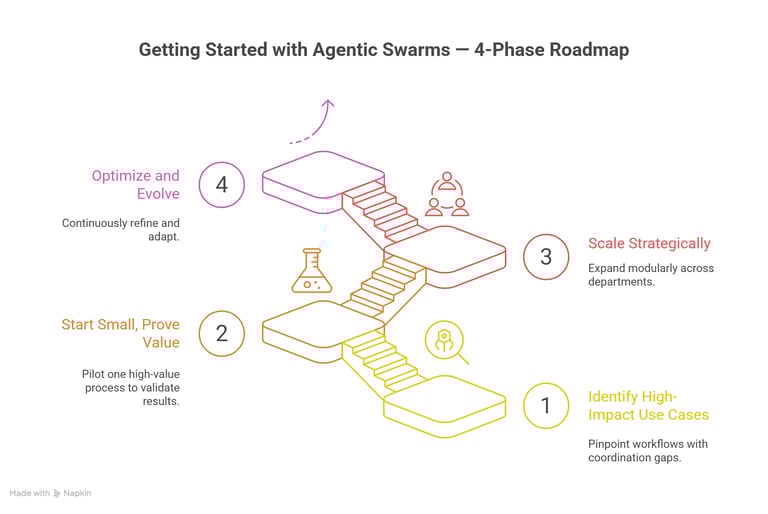
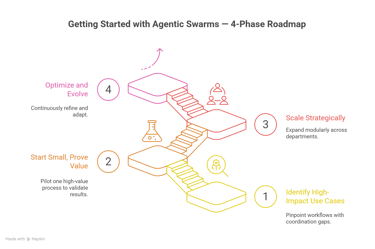
Phase 1: Identify High-Impact Use Cases (Week 1-2): Map processes that involve multiple handoffs, require coordination across teams, or create bottlenecks. Focus on areas where delays directly impact revenue or customer satisfaction.
Phase 2: Start Small, Prove Value (Month 1-2): Deploy a limited swarm for one high-value workflow. Measure time savings, error reduction, and team satisfaction. Build internal champions who see the value firsthand.
Phase 3: Scale Strategically (Month 3-6): Expand successful patterns to similar workflows. Add agents incrementally rather than trying to automate everything at once. Build on proven wins.
Phase 4: Optimize and Evolve (Ongoing): Track performance metrics. Identify where agents need additional capabilities or where handoffs could be smoother. Treat your swarm as a living system that improves over time.
Think Agentic AI is too complex to apply? Industry leaders with insights from our eBook “Agentic AI for Business Leaders” are simplifying workflows and gaining back 30+ hours each month. Grab your FREE copy now!
How Elevin Consulting Accelerates Your Agentic AI Journey
Recognizing these signs is only the beginning. The real transformation happens when organizations move from understanding Agentic Swarms to deploying them strategically across their business.
At Elevin Consulting, we help you bridge that gap through a structured, results-oriented approach that blends strategy, technology, and measurable outcomes. Our goal is to make advanced automation practical, scalable, and aligned with your objectives.
Our Agentic AI services are designed to:
1. Assess your readiness
We start by evaluating your existing systems, data flows, and operational priorities. This helps identify where multi-agent AI can deliver the most immediate and measurable value, ensuring your first step is a strategic one.
2. Develop tailored strategies
Every business faces unique challenges, and a one-size-fits-all AI plan rarely works. We create customized multi-agent roadmaps designed around your goals, whether that’s faster decision-making, improved efficiency, or better compliance visibility.
3. Implement and integrate seamlessly
Our team specializes in building and integrating multi-agent frameworks using leading-edge systems such as LangChain, AutoGen, and CrewAI. We connect these capabilities to your existing tools and data ecosystem so that every agent collaborates within your operational context, not in isolation.
4. Optimize for performance and scalability
Implementation is just the start. We help you establish ROI and efficiency metrics, fine-tune agent behaviors, and scale systems modularly as your business evolves. Our focus is on ensuring your Agentic AI continues to learn, adapt, and deliver sustained value over time.
With Elevin Consulting, you gain a partner focused on clarity and performance. We combine deep expertise in AI orchestration with an understanding of real-world business needs, helping you transform intelligent automation from a concept into a measurable competitive advantage.
Ready to explore the future of intelligent automation?
Don't let complexity hold your business back. If any of these 10 signs resonate with your current challenges, it’s time for a conversation.
Book a free discovery call with Elevin Consulting today and discover how Agentic Swarms can revolutionize your operations and drive unprecedented growth.
Excellence
Elevin Consulting: Your Partner in Growth.
Impact
© 2025 Elevin Consulting Pvt Ltd. All Rights Reserved
Trust
hello@elevinconsulting.com