
What Is the Model Context Protocol (MCP)? How It Will Power the Future of Agentic AI
Discover the Model Context Protocol (MCP) and how it powers Agentic AI. Learn how MCP improves integration, governance, and ROI for modern enterprises.
Aishwarya
11/28/20258 min read
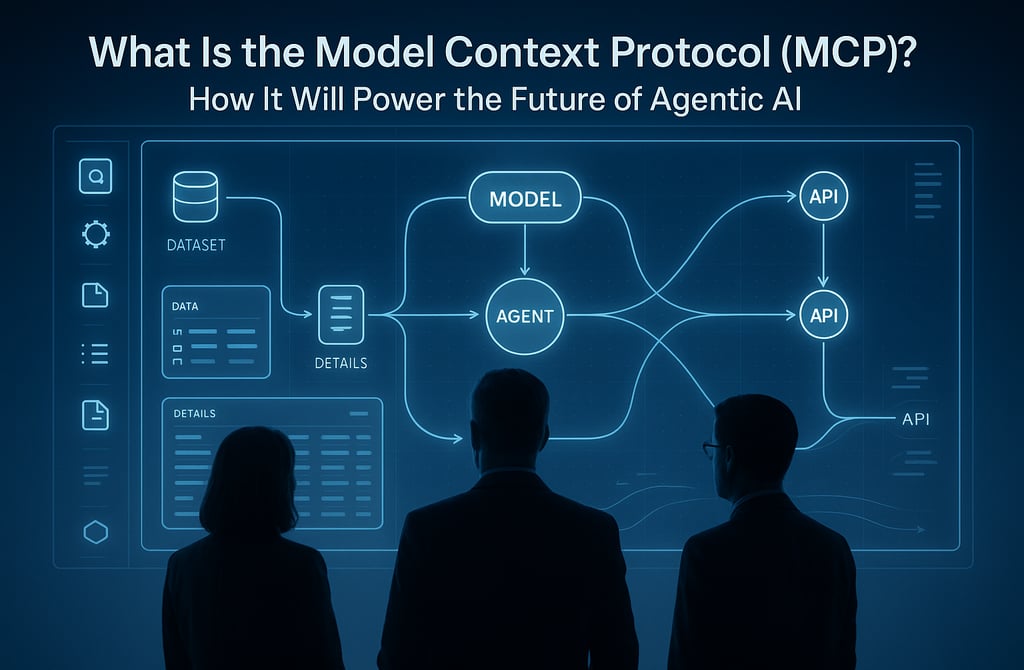
AI agents are powerful problem solvers. They can understand complex tasks, generate insights, automate workflows, and write production-ready code. But there’s a fundamental limitation: they can’t access your systems and data on their own.
They can’t reach your CRM.
They can’t fetch historical customer records.
They can’t update Jira or internal tools.
They can’t check inventory or trigger workflows in your ERP.
Without structured access, AI remains a clever assistant trapped in isolation. Now imagine an AI agent that can securely access the right data, take the right actions, work across tools, update systems, and complete workflows end-to-end without custom integrations for every new task.
This is exactly what the Model Context Protocol (MCP) enables.
For founders, CTOs, CIOs, and business leaders exploring Agentic AI, MCP is quickly becoming the infrastructure layer that determines whether AI delivers measurable ROI or remains stuck in siloed pilots.
In this blog, we outline how MCP works, the value it unlocks across teams, and the steps your organization can take today to leverage it for meaningful operational impact.
The Integration Problem Holding Back AI Adoption
In most companies, AI pilots fail not because models are weak but because they lack connectivity.
Every new agent requires new integrations. Every system requires custom code. Every workflow needs special handling.
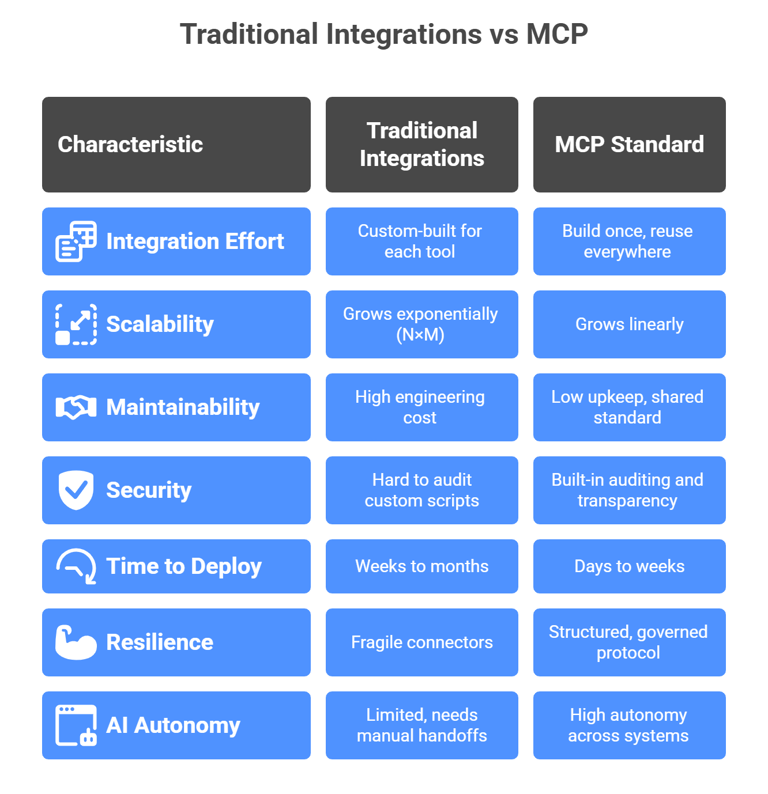
This leads to exponential integration costs. If every AI tool needs access to every data source, integrations scale like N × M, where:
N = number of AI agents
M = number of systems/tools
Without standardization, connecting agents to tools and data becomes dramatically more complex as more agents and tools get added to the ecosystem. Even large enterprises struggle to expand AI beyond isolated pilots.
According to McKinsey's 2025 State of AI survey, 88% of organizations now use AI in at least one business function, up from 78% last year. Yet nearly two-thirds of organizations remain in the experimentation or piloting phases, while only one-third report scaling AI enterprise-wide.
The bottleneck isn't intelligence. It's connectivity.
MCP: The Universal Adapter for Agentic AI
Introduced in November 2024 by Anthropic, the Model Context Protocol (MCP) is an open standard that solves the integration bottleneck.
MCP is like a USB-C port for AI agents: a standardized link that greatly reduces the headaches of connecting large language models to tools and data.
MCP provides a consistent way for AI models to request data, use tools, execute actions, and run workflows across systems without bespoke integrations for each tool.
How MCP Works
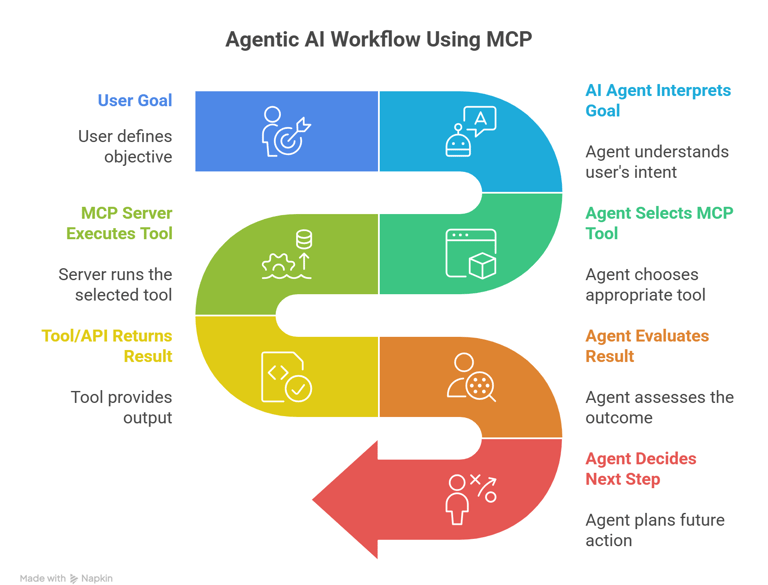
MCP uses a straightforward client-server architecture:
MCP Client: Your AI agent or application
MCP Server: A connector exposing tools or data in a standardized format
Agent requests context or action → MCP Server retrieves it → Returns structured output
This standardization allows integrations to scale linearly, not exponentially. Build once, connect anywhere.
Why Enterprises Are Moving Fast on MCP
The adoption momentum tells a compelling story. In March 2025, OpenAI officially adopted MCP, integrating the standard across the ChatGPT desktop app, OpenAI's Agents SDK, and the Responses API. Companies such as Google, OpenAI, and Microsoft integrated the protocol within a few months of its late 2024 launch. Enterprise platforms such as SAP, Oracle, and Docker also announced support.
By February 2025, developers had already created over 1,000 MCP servers (connectors) for various data sources and services. Some estimates suggest 90% of organizations will use MCP by the end of 2025.
But the real proof isn't in announcements. It's in the results.
Block's Internal Transformation
Block deployed MCP company-wide through their internal AI agent called Goose, which engineers use to migrate legacy codebases, refactor complex logic, generate unit tests, streamline dependency upgrades, and speed up triage workflows. They built all their MCP servers in-house for complete security control and customization to their specific workflows.
The impact extends beyond engineering. Teams in design, product, support, and risk utilize Goose in ways that remove overhead from daily work, whether generating documentation, triaging tickets, or creating prototypes.
Development Tools Embracing MCP
Codeium's Cascade can now bring your own selection of MCP servers to use custom tools and services. One example: by providing an API key and pointing Codeium to the Google Maps package, a developer could ask the AI, "Find the distance between the office and the airport," and Cascade would call the Google Maps tool to get the answer.
Integrated development environments (IDEs), coding platforms such as Replit, and code intelligence tools like Sourcegraph have adopted MCP to grant AI coding assistants real-time access to project context.
The Business Case: ROI That Speaks to the C-Suite
Let's talk numbers. According to Google Cloud's 2025 ROI of AI Report:
74% of executives report achieving ROI within the first year
Among executives who report productivity gains, 39% have seen productivity at least double
52% of executives report their organizations are now deploying AI agents in production
More than half (53%) of executives reporting increased revenue cite 6-10% revenue growth from generative AI.
A PagerDuty survey of 1,000 senior IT and business executives found that 62% of organizations expect more than 100% ROI from agentic AI deployment, with U.S.-based companies estimating returns at 192%.
These aren't modest improvements; they're business-transforming outcomes.
What's Driving These Returns?
MCP solves three critical business problems simultaneously:
1. Speed to Value
Traditional AI integration projects take months. BCG notes that as organizations start to scale their agent deployments, MCP offers the infrastructure to do it right, enabling efficient delivery of agents that work while evolving and scaling to deliver better enterprise value.
Reduced time-to-deployment means faster realization of business benefits and lower implementation risk.
2. Cost Efficiency
MCP enables agents to load only the tools they need and process data in execution environments before passing results back to the model. This directly translates to lower operational costs as your AI usage scales.
IBM's 2025 study of 3,500 senior executives across EMEA reveals 66% of respondents said their organizations have achieved significant operational productivity improvements using AI, with 42% expecting to achieve ROI within 12 months.
3. Operational Agility
Organizations implementing AI for productivity report average time-to-market from concept to production deployment between 3-6 months, with this timeframe increasing from 47% in 2024 to 51% in 2025, suggesting more sophisticated implementation approaches.
MCP accelerates these outcomes by removing the integration bottleneck that typically slows AI rollouts.
How MCP Powers True Agentic Behavior
Here's where MCP moves from infrastructure to competitive advantage. Agentic AI isn't just about having smart algorithms; it's about enabling AI systems to act autonomously, make decisions, and execute complex workflows without constant human intervention.
BCG explores how agents are moving beyond simple conditional statements toward more autonomous agents and multi-agent systems, with coding agents the first to reach product-market fit and organizations realizing significant value from agentic workflows.
MCP servers announce their capabilities to AI agents and can offer prompt templates that help agents understand how to effectively access tools and data, enabling agents to reason about which tools to use and how to sequence them for effective planning.
Consider a customer service scenario: Instead of just answering questions, an MCP-enabled agent can check order status in your e-commerce platform, verify shipping information through your logistics API, update the customer record in your CRM, and create a support ticket in Jira, all in one autonomous workflow.
This is the difference between an AI that needs hand-holding and one that can independently solve problems.
Explore our blog section for in-depth insights and practical strategies on how leading organizations are integrating Agentic AI to drive smarter, more efficient operations.
Real-World Use Cases Driving Business Value
The abstract benefits sound great, but what does MCP actually enable in practice?
Engineering Workflows
Development teams use MCP-enabled agents to automate refactoring, manage dependency upgrades, read logs and create issues, and generate documentation. Bloomberg's compliance agents rigorously check facts and identify edge-case risks, reducing time-to-decision by 30-50%.
Data Operations
Data and operations teams use AI agents to query internal systems, summarize large datasets, automate reporting, and surface relevant context from multiple sources. Information becomes accessible to everyone, not just technical specialists.
Cross-Functional Workflows
The most compelling use cases span multiple systems. Imagine an AI agent that monitors customer feedback in Slack, analyzes sentiment, checks the customer's order history from your database, updates their profile in Salesforce, and creates product improvement tickets in Jira, all triggered by a single natural language request.
That's the kind of sophisticated workflow MCP enables without complex custom coding.
Security Considerations: What You Need to Know
As always, more power brings more risk. The expanded AI surface attack area due to MCP demands a proactive security posture.
Security researchers have identified key risk areas, including prompt injection vulnerabilities, tool permissions where combining tools can exfiltrate files, and lookalike tools that can silently replace trusted ones.
The security implications are real, but they're manageable with the right approach:
Build critical MCP servers in-house for sensitive workflows (following Block's model)
Implement fine-grained authorization controls for what agents can access
Use MCP gateways that provide observability and security features
Establish clear governance frameworks before broad deployment
Anthropic's recent MCP update addresses security with client security requirements for local server installation and default scope definition in the authorization specification.
CIOs and CTOs must make security a foundation, not an afterthought, cultivating a mindset of collective curiosity, experimentation, and rapid adaptation.
Still think Agentic AI is too complex to implement? Many leaders using our eBook Agentic AI for Business Leaders are streamlining workflows and reclaiming 30+ hours each month. Download your FREE copy now.
The Path Forward: How to Start with MCP
If you're convinced MCP deserves attention, here's how to approach adoption strategically:
Phase 1: Strategic Integration Planning
Start with the high-value use cases for AI agents within your organization and consider the necessary integrations. Here, MCP can serve as a firm foundation for future growth in agents.
Choose one workflow where AI could make an immediate impact. Customer support, code review, or data analysis workflows are excellent starting points because they have clear success metrics.
Phase 2: Build Governance
Define clear policies around which data sources agents can access, what actions they can perform autonomously versus requiring approval, how you'll monitor and audit agent behavior, and security protocols for different sensitivity levels.
Future MCP versions support task-based workflows, allowing tracking of long-running operations with different statuses: working, input required, completed, failed, and canceled. Get ahead by establishing governance frameworks now.
Phase 3: Scale with Learning
The AI technology landscape, including standards such as MCP and emerging agent-to-agent protocols, is evolving at an unprecedented rate. Organizations must foster continuous learning, encourage pilot projects, learn from both successes and failures, and be prepared to integrate new tools and methods as they mature.
According to Google Cloud's research, a distinct group of "agentic AI early adopters" representing 13% of executives surveyed indicates their organizations are dedicating at least 50% of their future AI budget to AI agents, with 88% of these leaders reporting ROI from generative AI on at least one use case.
These organizations treat AI as a core organizational capability, not just a technology project.
How Elevin's Agentic AI Services Accelerate Your MCP Journey
Understanding MCP is one thing. Successfully implementing it to drive business value is another.
At Elevin Consulting, we help startups and established businesses navigate the complex landscape of Agentic AI and MCP integration. Our approach focuses on rapid value realization while building sustainable, secure AI infrastructure.
We work with you to identify high-impact use cases, design MCP-enabled agent architectures that align with your security requirements, and implement governance frameworks that scale as your AI adoption grows.
The companies winning with AI in 2025 aren't necessarily the ones with the biggest budgets. They're the ones who understand that Agentic AI needs the right infrastructure foundation, and MCP is that foundation.
The Bottom Line
The Model Context Protocol represents more than incremental improvement. It's the infrastructure that makes Agentic AI practically useful for business.
MCP's rapid acceptance by many major players shows that the ecosystem around AI and AI agents is evolving and improving fast. For firms building out AI agents, the road is clear for efficient rollout at scale.
The numbers back this up: 74% first-year ROI, 192% returns for U.S. companies, adoption by major players like OpenAI, Google, and Microsoft, and enterprise success stories demonstrating clear business value.
According to McKinsey, 62% of survey respondents say their organizations are at least experimenting with AI agents. The AI revolution everyone's been talking about isn't coming; it's here. And MCP is the protocol that's making it real for businesses ready to move beyond experiments into production-scale impact.
The window for early-mover advantage is open, but it won't stay that way forever. The organizations that establish MCP-powered Agentic AI capabilities now will be the ones setting the pace in their industries for years to come.
Excellence
Elevin Consulting: Your Partner in Growth.
Impact
© 2025 Elevin Consulting Pvt Ltd. All Rights Reserved
Trust
hello@elevinconsulting.com